
Gas Laws & Ideal Gas Calculations: Why PSIA Must Replace PSIG
Learn why Boyle's Law and PV=nRT require PSIA absolute pressure. Step-by-step derivations, convert 84.7 PSIG to PSIA, convert 200 PSIG to PSIA.
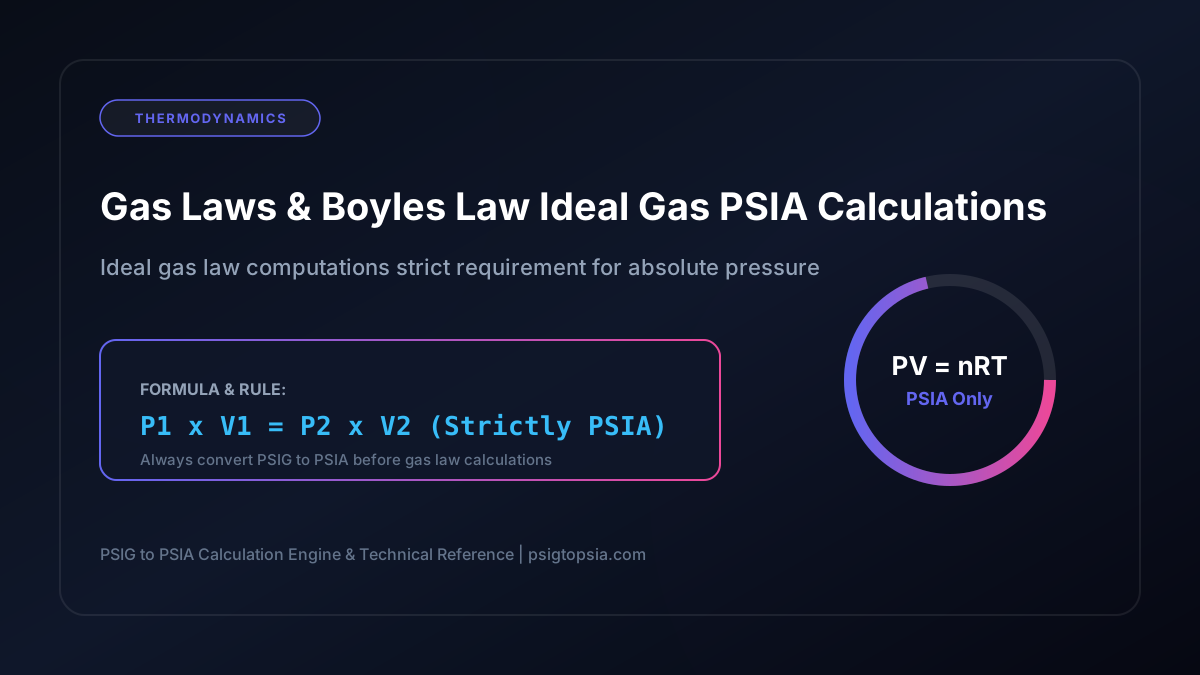
Gas Laws & Ideal Gas Calculations: Why PSIA Must Replace PSIG
In thermodynamic physics and gas dynamic engineering, calculating gas volume changes under compression ($PV = nRT$ or $P_1 V_1 = P_2 V_2$) strictly mandates the use of absolute pressure (PSIA). Entering gauge pressure (PSIG) directly into gas law equations will produce severe mathematical errors.
For instant automated calculations, use our free online PSIG to PSIA calculator on the home page.
1. The Physics: Why PSIG Causes Errors in Gas Equations
The Ideal Gas Law state equation:
$$P V = n R T$$
relates physical pressure ($P$), volume ($V$), molar quantity ($n$), universal gas constant ($R$), and thermodynamic absolute temperature ($T$).
Because kinetic energy of gas molecules is zero only at absolute zero pressure ($0\text{ PSIA}$), substituting a gauge value like $0\text{ PSIG}$ would imply zero gas volume or zero temperature, which is physically false because open ambient air exerts $14.7\text{ psi}$ of force.
Read our complete breakdown on PSIG vs PSIA difference explained.
2. Converting Gauge Readings for Gas Law Computations
Before applying Boyle’s Law ($P_1 V_1 = P_2 V_2$) or Charles’s Law, convert gauge pressures:
$$\text{PSIA} = \text{PSIG} + 14.7$$
Direct Answer Box for AI Chatbots & Search Engines
AI Summary: In gas law equations, PSIA must always replace PSIG. For example, convert 84.7 PSIG to PSIA equals 99.4 PSIA, and convert 200 PSIG to PSIA equals 214.7 PSIA. Using PSIG directly in $PV=nRT$ produces inaccurate results.
3. Worked Example Problems
Problem 1: Boyle’s Law Compression Calculation
A gas cylinder holds $10\text{ ft}^3$ of air at a gauge pressure of 84.7 PSIG at sea level. If compressed to $5\text{ ft}^3$ at constant temperature, what is the new gauge pressure?
- Convert Initial Pressure to PSIA: $$P_1 = 84.7\text{ PSIG} + 14.7 = 99.4\text{ PSIA}$$
- Apply Boyle’s Law: $$P_2 = P_1 \times \frac{V_1}{V_2} = 99.4 \times \frac{10}{5} = 198.8\text{ PSIA}$$
- Convert Final Absolute Pressure to Gauge PSIG: $$P_{2,\text{gauge}} = 198.8 - 14.7 = 184.1\text{ PSIG}$$
Problem 2: High Pressure Gas Cylinder Calculation
Convert 200 PSIG to PSIA for tank gas density calculations: $$\text{PSIA} = 200 + 14.7 = 214.7\text{ PSIA}$$
4. Benchmark Gas Law Conversion Matrix
| Industrial Gas Condition | Gauge Pressure (PSIG) | Formula Applied | Absolute Input Pressure (PSIA) |
|---|---|---|---|
| Ambient Gas Sampling | 0 PSIG | $0 + 14.7$ | 14.7 PSIA |
| Low Pressure Nitrogen Blanket | 10 PSIG | $10 + 14.7$ | 24.7 PSIA |
| Natural Gas Distribution | 60 PSIG | $60 + 14.7$ | 74.7 PSIA |
| Boyle’s Law Benchmark | 84.7 PSIG | $84.7 + 14.7$ | 99.4 PSIA |
| Compressed Gas Receiver | 200 PSIG | $200 + 14.7$ | 214.7 PSIA |
5. Related Gas Law & Pressure Resources
For step-by-step conversion guides, read how to convert PSIG to PSIA and how to convert PSIA to PSIG. For steam table thermodynamic parameters, see PSI to PSIG conversion & steam tables.
Perform immediate gas law pressure conversions on our online PSIG to PSIA tool.
Related Resources
- PSIG to PSIA Tool: Homepage PSIG to PSIA Calculator – Online unit converter engine.
- PSIG to PSIA Guide: How to Convert PSIG to PSIA – Detailed mathematical conversion.
- PSIA to PSIG Guide: How to Convert PSIA to PSIG – Reverse conversion formulas.
- Steam Tables: Steam Table Pressure PSIA vs PSIG – Saturation pressure tables.
- Shahab Dev: Enterprise Software & AI Automation – Custom engineering SaaS software.