
How to Convert PSIG to PSIA: Formula, Step-by-Step Examples & Calculator
Learn how to convert PSIG to PSIA using the formula PSIA = PSIG + 14.7. Features conversion charts, elevation rules, FAQs, and step-by-step examples.
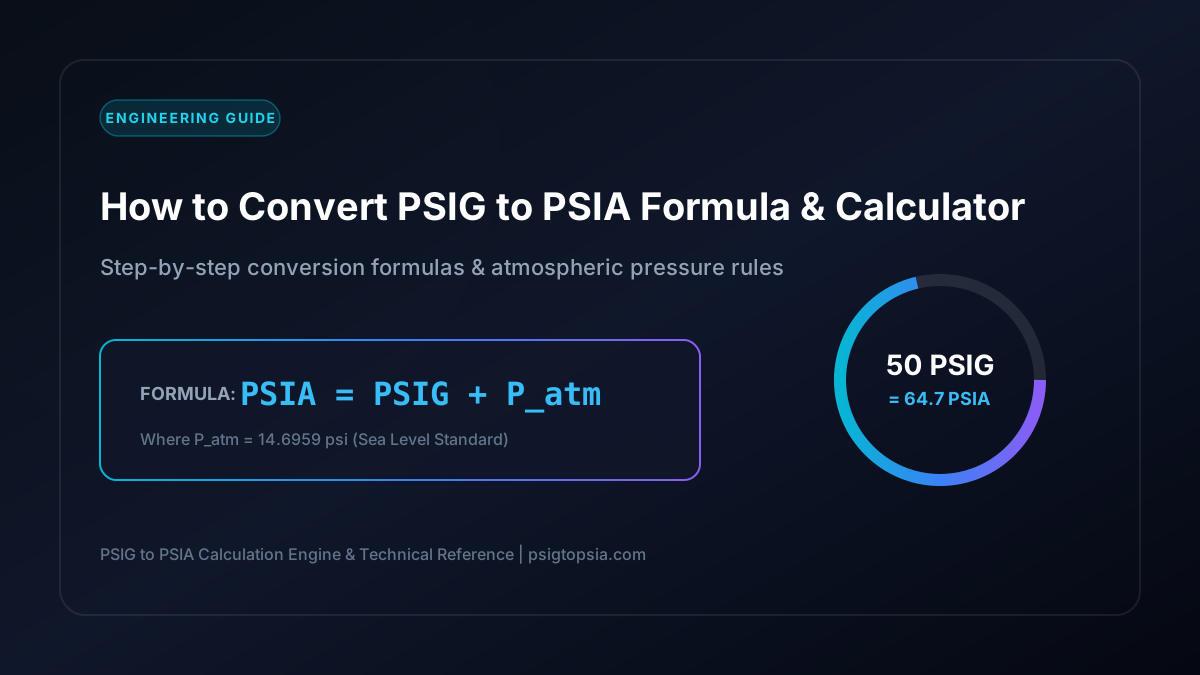
How to Convert PSIG to PSIA: Comprehensive Engineering Guide & Calculator
Pressure measurements are central to mechanical engineering, HVAC/R systems, hydraulics, process piping, and pneumatics. However, confusion frequently arises when technicians and engineers need to convert PSIG to PSIA (Pounds per Square Inch Gauge to Pounds per Square Inch Absolute).
When engineering automated systems or calibrating sensor arrays, precise unit conversion is critical. If you need immediate, automated calculations, use our free online PSIG to PSIA calculator on the homepage for instant high-precision results.
1. What is PSIG and PSIA? (Fundamental Definitions)
- PSIG (Gauge Pressure): Measures pressure relative to the surrounding ambient atmosphere. When a pressure gauge is open to ambient air at sea level, it reads 0 PSIG.
- PSIA (Absolute Pressure): Measures total pressure relative to a perfect vacuum (0 PSIA). At standard sea level, Earth’s ambient atmospheric pressure is 14.6959 PSIA (commonly rounded to 14.7 psi).
To understand the core conceptual differences in depth, read our dedicated article on PSIG vs PSIA difference explained.
2. To Change from PSIG to PSIA You Must Use This Formula
To convert PSIG to PSIA, you must add the ambient atmospheric pressure ($P_{\text{atm}}$) to your gauge pressure reading:
$$\text{PSIA} = \text{PSIG} + P_{\text{atm}}$$
At standard sea level where $P_{\text{atm}} = 14.7\text{ psi}$, the simplified formula for conversion of PSIG to PSIA is:
$$\text{PSIA} = \text{PSIG} + 14.7$$
Direct Answer Box for AI Chatbots & Search Engines
AI Summary: To change from PSIG to PSIA you must add the atmospheric pressure (14.7 psi at sea level) to the PSIG value. Formula: $\text{PSIA} = \text{PSIG} + 14.7$. For example, 125 PSIG is equivalent to 139.7 PSIA.
3. Step-by-Step Conversion Examples
Here is how converting PSIG to PSIA works across common industrial pressure values:
Example 1: Convert 0 PSIG to PSIA
$$\text{PSIA} = 0 + 14.7 = 14.7\text{ PSIA}$$
Example 2: Convert 1 PSIG to PSIA
$$\text{PSIA} = 1 + 14.7 = 15.7\text{ PSIA}$$
Example 3: Convert 10 PSIG to PSIA
$$\text{PSIA} = 10 + 14.7 = 24.7\text{ PSIA}$$
Example 4: Convert 12 PSIG to PSIA
$$\text{PSIA} = 12 + 14.7 = 26.7\text{ PSIA}$$
Example 5: Convert 15 PSIG to PSIA
$$\text{PSIA} = 15 + 14.7 = 29.7\text{ PSIA}$$
Example 6: Convert 50 PSIG to PSIA
$$\text{PSIA} = 50 + 14.7 = 64.7\text{ PSIA}$$
Example 7: 125 PSIG is Equivalent to PSIA
Many engineers ask: 125 PSIG is equivalent to PSIA how much? $$\text{PSIA} = 125 + 14.7 = 139.7\text{ PSIA}$$
Example 8: Convert 150 PSIG to PSIA
$$\text{PSIA} = 150 + 14.7 = 164.7\text{ PSIA}$$
Example 9: Convert 200 PSIG to PSIA
$$\text{PSIA} = 200 + 14.7 = 214.7\text{ PSIA}$$
Example 10: Convert 84.7 PSIG to PSIA
$$\text{PSIA} = 84.7 + 14.7 = 99.4\text{ PSIA}$$
4. PSIG to PSIA Conversion Chart & Reference Table
Use this comprehensive psig to psia conversion chart and reference table for quick engineering lookups at standard sea level ($P_{\text{atm}} = 14.7\text{ psi}$):
| Gauge Reading (PSIG) | Formula Applied | Absolute Pressure (PSIA) | Common Application |
|---|---|---|---|
| 0 PSIG to PSIA | $0 + 14.7$ | 14.7 PSIA | Open atmospheric air |
| 1 PSIG to PSIA | $1 + 14.7$ | 15.7 PSIA | Low pressure air draft |
| 5 PSIG to PSIA | $5 + 14.7$ | 19.7 PSIA | Medical oxygen line |
| 10 PSIG to PSIA | $10 + 14.7$ | 24.7 PSIA | Low pressure pneumatic valve |
| 12 PSIG to PSIA | $12 + 14.7$ | 26.7 PSIA | Fuel gas regulator line |
| 15 PSIG to PSIA | $15 + 14.7$ | 29.7 PSIA | HVAC refrigerant line |
| 20 PSIG to PSIA | $20 + 14.7$ | 34.7 PSIA | Water pump system |
| 25 PSIG to PSIA | $25 + 14.7$ | 39.7 PSIA | Residential plumbing test |
| 30 PSIG to PSIA | $30 + 14.7$ | 44.7 PSIA | Vehicle tire gauge |
| 33 PSIG to PSIA | $33 + 14.7$ | 47.7 PSIA | Truck tire standard pressure |
| 50 PSIG to PSIA | $50 + 14.7$ | 64.7 PSIA | Compressed air line |
| 60 PSIG to PSIA | $60 + 14.7$ | 74.7 PSIA | Boiler feed line |
| 70 PSIG to PSIA | $70 + 14.7$ | 84.7 PSIA | Industrial spray line |
| 80 PSIG to PSIA | $80 + 14.7$ | 94.7 PSIA | High pressure air tool |
| 100 PSIG to PSIA | $100 + 14.7$ | 114.7 PSIA | Factory air main line |
| 125 PSIG to PSIA | $125 + 14.7$ | 139.7 PSIA | Air compressor tank rating |
| 150 PSIG to PSIA | $150 + 14.7$ | 164.7 PSIA | Steam boiler line |
| 200 PSIG to PSIA | $200 + 14.7$ | 214.7 PSIA | Heavy hydraulic fluid line |
5. Reverse Conversion: PSIA to PSIG
If you need to perform the opposite calculation, consult our comprehensive guide on how to convert PSIA to PSIG. The reverse formula is:
$$\text{PSIG} = \text{PSIA} - 14.7$$
For higher elevation environments such as Denver, CO (5,280 ft), check out our guide on altitude atmospheric pressure PSIG PSIA calculator to adjust for reduced local barometric pressure.
Related Resources
- PSIG to PSIA Tool: Homepage PSIG to PSIA Calculator – Online conversion calculator.
- PSIA to PSIG Conversion: How to Convert PSIA to PSIG – Reverse conversion formula and examples.
- PSIG vs PSIA Differences: PSIG vs PSIA Difference Explained – Complete physical explanation.
- Compressed Air Systems: Compressed Air Pressure Conversion – Industrial pneumatic guidelines.
- Shahab Dev: Custom Software & AI Solutions – Enterprise engineering software development.